
Some of our researchers participated at this years CHI, the largest conference in the field of human-computer interaction. In April 2026 the conference took place in Barcelona, comprising five intense days of 26 parallell tracks with papers, panels, interactive demos, meetups, workshops and a general mingling with old and new friends from across the field.

A strong theme this year was, not surprisingly, the current impact of LLMs, with the program dominated by sessions focusing on AI in one way or the other. Some very interesting papers on this theme included those presented by Mattias Rost and Jakob Tholander, who both we hope will be visiting UmArts later this year. Other important work included studies on the invisible labour of algorithm training, relating to several projects presented and discussed at UmArts recently. There was also a workshop on the Body in Designing (Through) AI, co-hosted by Pedro Sanches from Informatics at Umeå University.

Another strong thread was research concerned with practices of care, with Karey Helms from Umeå Institute of Design being part of an ambitious and timely review paper: Caring about Care: A Meta-Narrative Review of HCI Research on Care, and Irene Kaklopoulou from Informatics presented a paper on Design for Dis/Ability: A Crip Inquiry into Personal Energy Tracking.

Ylva Fernaeus, Professor in Design and Deputy Director of UmArts, chaired a session on the theme of fabrication techniques with some very intriguing explorations that could be of interest, especially to some of the researchers affiliated with our Postindustrual Making group.

Together with partners in the Wasp-HS project Playmachines, Ylva also participated in the third CAMCAD workshop on children’s co-agency with AI, presenting a position paper (titled “It’s a Scam: On the Deceptions of Robotic Playmates”) engaged in inspiring discussion on the topics of children’s culture, smart products and real world challenges when designing in the current era of “fake”. She also had a provocation paper presented visually (see below) during the opening reception, inspiring some good discussions around the theoretical lineage of the field:
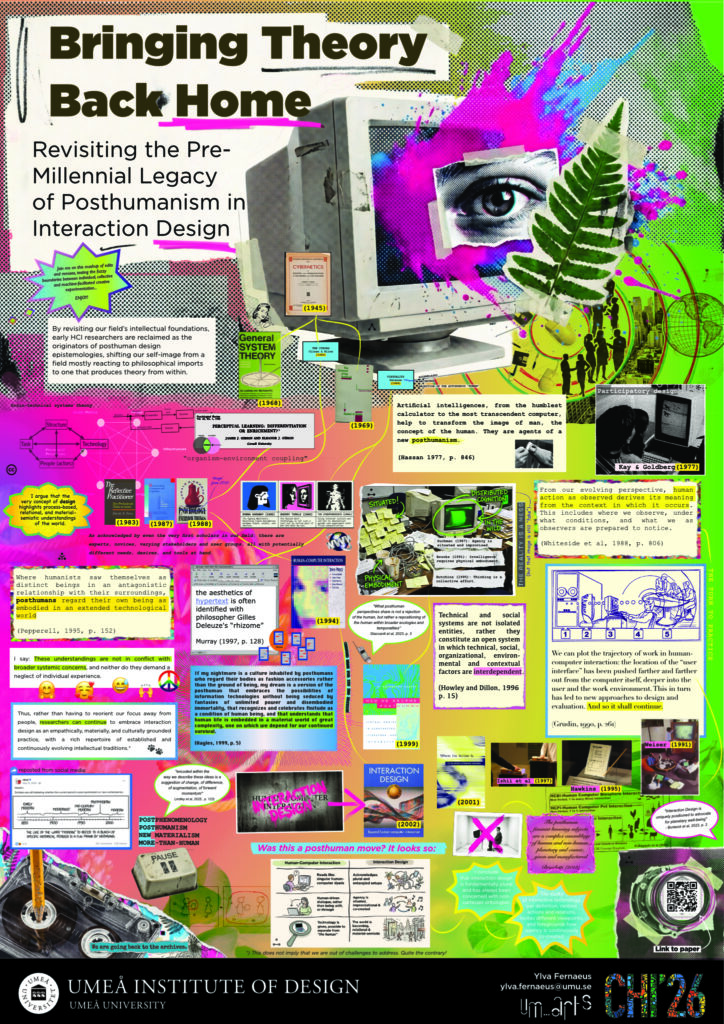
Image: Poster that fleshes out some of the historical lineage of theory in HCI, as one already from the beginning shaped by posthuman philosophies (click to view larger).

The first Post Industrial Making Working Group meeting brings together researchers exploring possibilities and challenges in the intersection of traditional sloyd/craft and digital design, between hi-tech and low-tech making. Previous example projects include combining traditional and cultural woodcraft with digital laser cutting, and more technical explorations from architectural perspectives on making with recycled and living materials. Another focus is on contemporary subcultures of contemporary makers in relation to traditional crafts, framed as modes of sustainable, post-industrial design practice. The working group also brings attention to tinkering as an investigative practice within the creative fields, ranging from hacking, coding, circuit-bending, and bricolage. 

In a Nordic context sloyd traditions embody a specific form of cultural heritage encompassing particular materials and techniques. Research in this working group spans all creative disciplines and works together to publish research articles, conduct hands-on workshops, and exhibitions. Examples include post-industrial approaches to high tech design, new sustainable forms and materials for architecture, traditional woodworking supported by digital fabrication tools.

Like to Join? Please contact working group chair Ylva Fernaeus  Associate Professor at Umeå Institute of Design, and Deputy Director of UmArts.

This group brings together researchers exploring possibilities and challenges in the intersection of traditional sloyd/craft and digital design, between hi-tech and low-tech making. Previous example projects include combining traditional and cultural woodcraft with digital laser cutting, and more technical explorations from architectural perspectives on making with recycled and living materials. Another focus is on contemporary subcultures of contemporary makers in relation to traditional crafts, framed as modes of sustainable, post-industrial design practice. The working group also brings attention to tinkering as an investigative practice within the creative fields, ranging from hacking, coding, circuit-bending, and bricolage.

In a Nordic context sloyd traditions embody a specific form of cultural heritage encompassing particular materials and techniques. Research in this working group spans all creative disciplines and works together to publish research articles, conduct hands-on workshops, and exhibitions. Examples include post-industrial approaches to high tech design, new sustainable forms and materials for architecture, traditional woodworking supported by digital fabrication tools.

The Post Industrial Making Group is chaired by Ylva Fernaeus, Associate Professor at Umeå Institute of Design, and Deputy Director of UmArts.

UmArts is leading research in Art, Architecture, Design and Artificial Intelligence (AI) at Umeå University in partnership with the Wallenberg AI, Autonomous Systems and Software Program – Humanities and Society (WASP-HS) and Umeå University’s Centre for Transdisciplinary AI (TAIGA). In 2023, curator Sarah Cook joined UmArts as the WASP-HS Guest Professor in Art and AI in partnership with Bildmuseet, Umeå School of Architecture (UMA), and Umeå Institute of Design (UID).

The Art and AI working is a group is chaired by Guest Professor Sarah Cook, and includes UmArts postdocs, mentors and artists in residence who are working with AI to share their research and develop new collaborative projects. The group considers how arts research can contribute to the social and ethical discourses of AI and machine learning, working in partnership with museums and galleries, artists and curators. The programme critically interrogates the aesthetics and politics of AI, collaborating with, and challenging the algorithmic logic underpinning hardware and software development. We are interested in how creative encounters can allow publics to experience and engage with the ethical considerations and societal shifts that widespread use of AI will bring and feeding that back into AI development.

The Octopus Club

The Octopus Club have been reading ‘The Maniac’  by Benjamín Labatut about the life of John von Neumann nominated by Dimitri. This is contrasted with ‘Klara and the Bomb’ by artist Crystal Bennes, about Klara von Neumann who was married to John, nominated by Ele. The comparison provides insights into the history of computing and AI from biographical and feminist artistic perspectives.