
Some of our researchers participated at this years CHI, the largest conference in the field of human-computer interaction. In April 2026 the conference took place in Barcelona, comprising five intense days of 26 parallell tracks with papers, panels, interactive demos, meetups, workshops and a general mingling with old and new friends from across the field.
A strong theme this year was, not surprisingly, the current impact of LLMs, with the program dominated by sessions focusing on AI in one way or the other. Some very interesting papers on this theme included those presented by Mattias Rost and Jakob Tholander, who both we hope will be visiting UmArts later this year. Other important work included studies on the invisible labour of algorithm training, relating to several projects presented and discussed at UmArts recently. There was also a workshop on the Body in Designing (Through) AI, co-hosted by Pedro Sanches from Informatics at Umeå University.
Another strong thread was research concerned with practices of care, with Karey Helms from Umeå Institute of Design being part of an ambitious and timely review paper: Caring about Care: A Meta-Narrative Review of HCI Research on Care, and Irene Kaklopoulou from Informatics presented a paper on Design for Dis/Ability: A Crip Inquiry into Personal Energy Tracking.
Ylva Fernaeus, Professor in Design and Deputy Director of UmArts, chaired a session on the theme of fabrication techniques with some very intriguing explorations that could be of interest, especially to some of the researchers affiliated with our Postindustrual Making group.
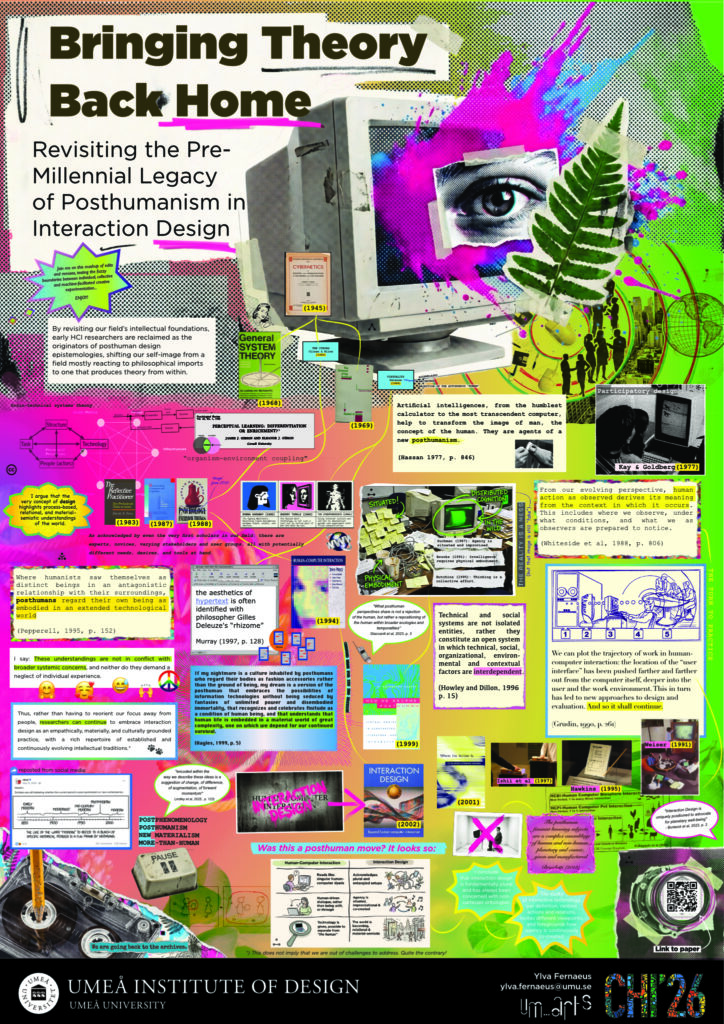
Together with partners in the Wasp-HS project Playmachines, Ylva also participated in the third CAMCAD workshop on children’s co-agency with AI, presenting a position paper (titled “It’s a Scam: On the Deceptions of Robotic Playmates”) engaged in inspiring discussion on the topics of children’s culture, smart products and real world challenges when designing in the current era of “fake”. She also had a provocation paper presented visually (see below) during the opening reception, inspiring some good discussions around the theoretical lineage of the field: