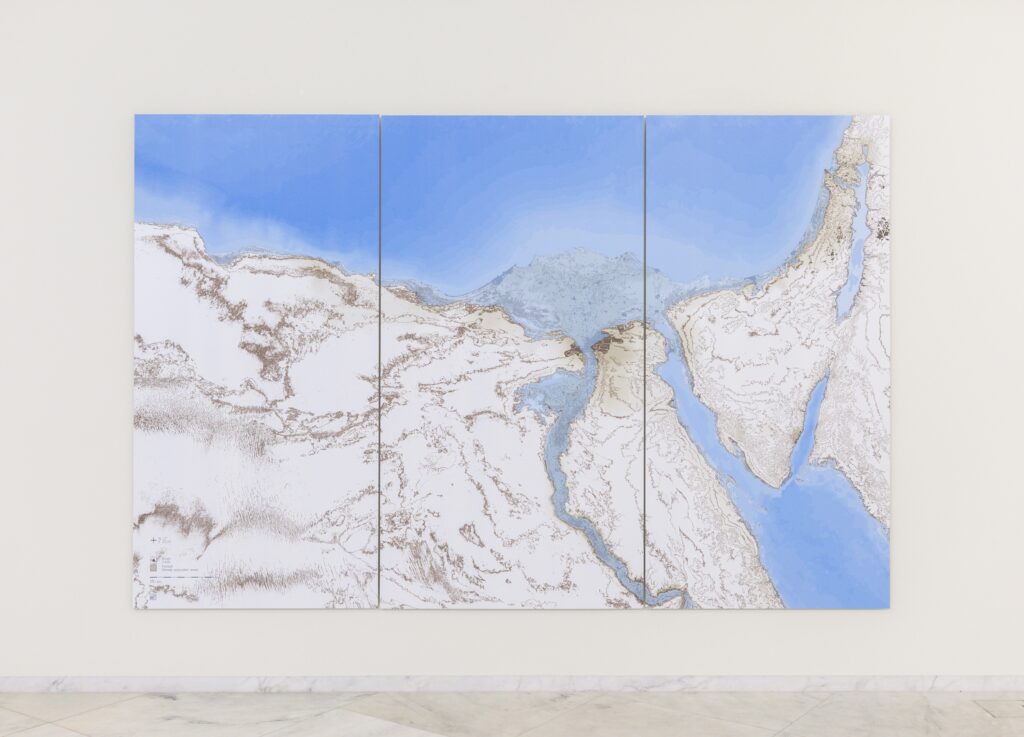

Artists Rúrí (Iceland) and Elena Mazzi (Italy) present their work at the artist-run space Galleri Verkligheten. The parallel projects are curated by Maria Luna Nobile as a contribution to the EURAU26 LATITUDES Symposium Situated reflections on architectural research and as an off-summit exhibition for the Arctic Arts Summit, to create a public space for dialogue between art and architectural research.
The artworks act as an observatory, where maps and cartographies are tools to measure, interpret and speculate on environmental and geopolitical changes in the Arctic. Rúrí’s Future Cartography visualizes future coastlines shaped by climate change through scientific data. Whilst Mazzi’s Polar Silk Road examines the economic, ecological, and political implications of emerging Arctic trade routes.
Rúrí is a visual artist whose art focuses on humankind and its relation to the Earth and the Cosmos. Since 1999 many of her works raise questions about water, from the impact of Aluminium smelting on waterflows in Iceland, to the shortage of safe water for consumption, and the effects of melting icecaps on shorelines. Over a career spanning more than five decades, Rúrí, has centered her artistic practice on moral and existential questions that confront inhumanity, imperialism, capitalism, social injustice, and environmental destruction. A pioneer of performance art in Iceland, she has worked across a wide range of media including painting, sculpture, photography, film, multimedia installation, writing, and performance. Her groundbreaking performance Golden Car (1974) was among the first works in Iceland to engage explicitly with political activism. Rúrí represented Iceland at the 2003 Venice Biennale with Archive – Endangered Waters, an interactive multimedia installation presenting visual and acoustic data from 52 waterfalls threatened by dam construction in the Icelandic highlands. Rúrí was awarded the Icelandic Visual Arts Council´s Honorary Award 2026.
Elena Mazzi investigates the geopolitics of the Arctic through undertaking artistic research on residencies across Greenland, Iceland, Svalbard and Sapmi to develop new artworks in dialogue with the community. Elena’s project the Upcoming Polar Silk Road defines the new geopolitical and economic spaces in the Arctic region. The artwork is an analysis of the complex intertwining of economy, geopolitics, ecology and mobility within the Arctic regions most affected by the infrastructural and political transformations linked to the Polar Silk Road. This new axis will connect Europe, Russia and China by opening a ‘Northern Route’ over the circumpolar region to exploit the subsoil of the Arctic seas which contains oil, gas, uranium, gold, platinum and zinc. The work consists of a video documenting key places of this transition, such as the possible new port of Finnafjörður in the north-east of the island and the nearby CIAO Institute, the new meteorological-astronomical observatory founded to cement the agreement between China and Iceland, countries that are now protagonists in the process of defining new trade routes. Elena Mazzi is undertaking a practice-based PhD at Villa Arson in Nice, France.
The Future Cartographies exhibition is hosted by Galleri Verkligheten in collaboration with: Umeå School of Architecture; UmArts Centre for Research in Architecture, Design and the Arts, and the Arctic Centre at Umeå University; Arctic Arts Summit.