
Analogue and digital Radio broadcasting is an essential communications network in times of peace and crisis. This series of events includes a discursive panel at the Arctic Arts Summit, followed by a public film screening and meet-up for those interested in art and radio in the Arctic. The events consider radio as a cultural space for creative radio art and performance, capturing real time experience, archiving important debates, building resilient communities and networks for preparedness. As part of the panel we will have a live broadcast from the LungA Radio School and Seyðisfjörður Community Radio in Iceland in collaboration with radio artist Karen Werner, with an international panel to discuss how radio works in the Arctic, for Indigenous communities, and across frequencies.
Schedule: Thursday 18 June
13.00-14.00 Resilient Radio Panel 12A, * Summit pass required.
18.00-19.30 Resilient Radio Film Screening, Folketsbio
20.00 -23.00 Radio Rendezvous:Bishops Arms, Dorset room.
Resilient Radio Film Screening
UmArts presents two artists’ documentaries investigating analogue radio in Sweden and Norway that reflect on the resilience of amateur and analogue knowledge. After the screening the artists Astrid Ardagh (Norway) and Helena Wikström (Sweden) will be in discussion with curator Ele Carpenter and researcher Pedro Sanches, Umeå University.
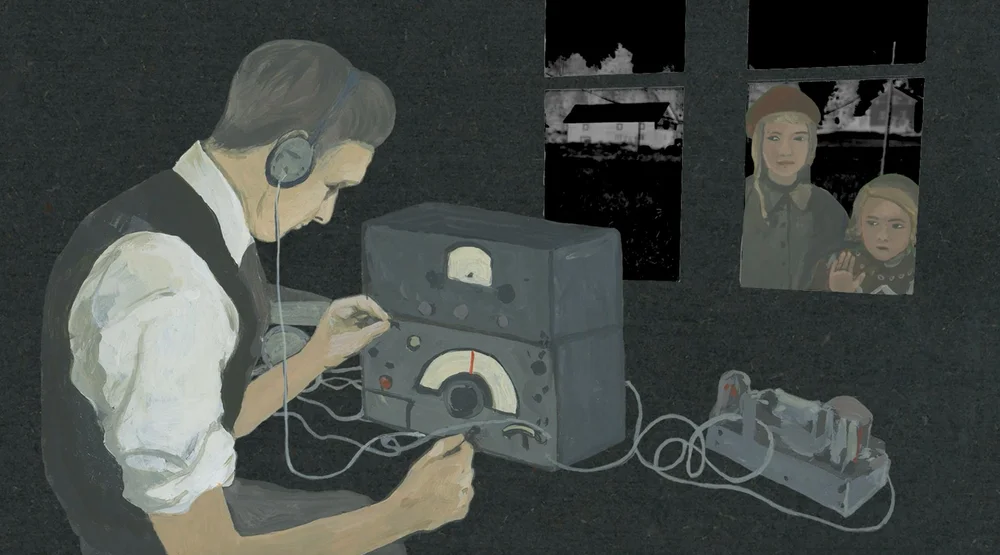
Astrid Ardagh, Director, Ishavringen /On Air, 2024. (20:26 mins) A major cyberattack in the wake of the Ukrainian war left Norway’s Arctic Islands without means to communicate. On Air explores the vital role of radio amateurs in keeping our backup communication systems alive. Set against a striking arctic backdrop, the film reflects on society’s digital vulnerabilities and the enduring importance of analog technology.
Helena Wikström, Black Peter, 2018. (28 mins) The intriguing story of how the first radio pirates in Sweden, two woodsmen from Lomsjö, challenged the Swedish radio monopoly while the Swedish Security police chased them throughout the northern Swedish forests in the 1950s.
Pedro Sanches will moderate the session, he is an Associate Professor at the Department of Informatics, at Umeå University whose research draws on feminist epistemologies to design biodata-driven and AI-based technologies for health and wellbeing and performing arts. Pedro applies speculative and somaesthetic design tactics to consider situated lived experiences when creating with data as material.
Resilient Radio Discursive Panel
Moderator: Ele Carpenter
Ele Carpenter is Director of the UmArts Centre for Research in Architecture, Design and the Arts at Umeå University where she is Professor of Interdisciplinary Art and Culture at the School of Architecture. Her curatorial research in nuclear culture takes inspiration from Paul Baran’s network topologies for a communications network to withstand a nuclear war (1964), and the asymmetrical networks of the international Womens Peace Movement.
Panelists:
Julie Grenier is from Kuujjuaq, a small community in Nunavik, Northern Québec. She currently resides in Notre-Dame-de-l’ile-Perrot, a small community west of Montreal, with her husband and three children. Having an Inuk mother and Francophone father, she was raised with both sets of values from those cultures. Julie is currently working as the Director General for Taqramiut Nipingat Incorporated (TNI), a regional radio and television production company that serves the Inuit of Nunavik Northern-Quebec and broadcasts 100% in the Inuktitut language. She has held different positions at TNI before taking on the director general position and she directed many documentaries and series aired on APTN on Nunavik’s community television network (NCTv) including a feature about Sheila Watt-Cloutier. In 2021, Julie was appointed to the Inuit Art Foundation Board of Directors, where she is the Secretary Treasurer. Julie has been on the Board of Directors of APTN for 11 years and is also the current Chair of the Board of Directors of APTN, a position she has held for 7 years.
Ole-Isak Mienna is the founder of a production company with a focus on taking assignments as an editor and producer since 2024. He is the former channel manager and publisher at Swedish Sámi Radio (1999 – 2021) and the former editorial director and publisher at SVT Sápmi (2015 – 2017). Between 2002 and 2007 he was part of the Nordic project steering group that initiated and started up a Sámi radio station in Lovozero on the Kola Peninsula. He is currently engaged as editor and producer in a TV and podcast series assignment for SVT and Sámi Radio that will be released to the public in early 2027.
Marko Peljhan is a theatre and radio director, artist researcher and tactical media worker. In the 90s, he was the founder of Projekt Atol and co-founder of LJUDMILA, one of the first media labs in Eastern Europe. From 1994 he worked on Makrolab, a telecommunications, migrations and weather systems research ecology station. Radio is central to his practice, he led the Insular Technologies initiative, proposing an autonomous high-frequency radio network, and operates in the radio spectrum as S54MX. Since 2004 he works on the Interpolar Transnational Art Science Constellation and from 2008, Peljhan and American-Canadian artist Matthew Biederman have led the Arctic Perspective Initiative, focusing on the global significance of the Arctic geopolitical, natural and cultural spheres. He helped conceive and launch Slovenia’s first remote sensing satellite, NEMO-HD, in 2020, serving as coordinator of international cooperation for the SPACE-SI Centre of Excellence for Space Sciences, he also works on autonomous systems and related defences against them. He is the recipient of the 2001 Golden Nica Prize at Ars Electronica with Carsten Nicolai and several other prizes; his work has been exhibited internationally at biennales (Venice and others), documenta, YCAM, ICC-NT, PS.1. MOMA, New Museum, Garage and others. Peljhan serves as professor and director of the MAT Systemics Lab at the University of California Santa Barbara.
Johan Malmstedt is a postdoctoral researcher in digital humanities at the University of Gothenburg and metaLAB @ Harvard. He holds a PhD in Media and Communication Studies from Umeå University, where his dissertation examined the stylistic development of Swedish radio broadcasting (1980–1999) through computational methods. His research explores the intersection of signal processing and media history, with a focus on audiovisual forms as objects of analysis. He currently leads the project Audiovisual Aesthetics in Formation, which investigates crossmodal alignment in Swedish and American public service television during the 1970s and 1980s using machine learning. Malmstedt has a background in the history of ideas and collaborates in several interdisciplinary projects, including Soundscapes of Warning, Welfare State Analytics: Text Mining and Modeling Swedish Politics, Media & Culture, 1945–1989, and Lägg ut! Lägg ut!: Terrorismens audiovisuella mediering i svensk television 1968–1987.
Seyðisfjörður Community Radio is a platform founded in Iceland 2016, an experimental community radio constantly in the making. It is weaving the act of listening with the act of radio-making into the act of community. It is entangled with the LungA School, an independent, artist-led institution and situation focusing on experimentation, community and art. There is hosted Radio School, a free and participatory schooling experiment taking place in/on/through, not a school about radio. Considering the radio as a shared praxis and a space, it is where they speak/talk/listen/translate/read together in an open-ended network of people and places where everyone is welcome to contribute, participate and listen in. www.seydisfjordurcommunityradio.net / https://www.lungaschool.is/en/radio
Karen Werner is an Austrian-based artist and sociologist making experimental radio works and performances for broadcast and narrowcast. She creates living installations and radio stations of various scales and durations, including SkottegatenFM and Radio Multe. Werner’s artworks have been part of Bergen Assembly 2025 (Norway), Finnmark Flicker + Barents Spektakle (Norway), Tsinghua Museum (China), Tonspur Kunstverein Wien + Maribor (Austria/ Slovenia), MAG3 (Austria), Kone Foundation (Finland), Kunstradio (Austria), Wave Farm (US), Australian Broadcast Corporation and others. Werner writes on a range of artistic and sociological topics including re-imagining the radio station, dialogical aesthetics and conversation as co-creation, spiritual activism, radio auto-ethnography, community economies and artistic research. She is University Professor of Artistic Research at the Mozarteum’s PhD in the Arts Program at the Institute for Open Arts in Salzburg, Austria, where she is co-founding a university-wide experimental radio station dedicated to art + research co-creation. Karenwerner.net
